
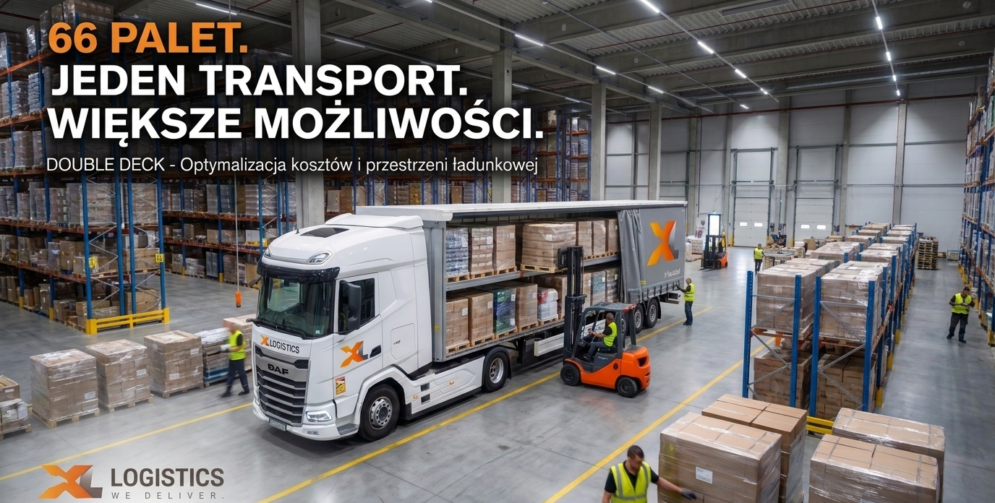
The Double Deck semi-trailer has a second, movable loading level and can hold up to 66 Euro pallets instead of the standard 33. However, the additional deck does not increase the allowable payload, which is approximately 24 metric tons for a combination with a gross vehicle weight rating of 40 metric tons. Therefore, this solution works only for light and bulky goods that cannot be stacked. Below you’ll find the conditions the cargo must meet for the second level to actually reduce the cost per pallet.
Why doesn’t the rate per kilometer indicate how much transportation costs?
Because it’s based on the distance traveled, not the cargo transported. The rate per kilometer is easy to compare across different offers, which is why it’s a winning argument in business negotiations. However, the product is subject to a different metric: the cost per pallet or per metric ton. These two metrics can move in opposite directions.
This is evident with light and bulky cargo. The space in the trailer runs out long before the load capacity is exhausted. The semi-trailer is traveling full, the meter is charging the full rate, and there are 12 metric tons on board out of a possible 24. You’re paying for space you’re not using.
What is a Double Deck semi-trailer, and how many pallets does it hold?
It’s a semi-trailer with a second loading level, supported by a beam-and-rail system mounted on the walls. The cargo rests on two decks rather than one on top of the other, so the lower layer doesn’t bear the weight of the upper one. A standard curtain-sided semi-trailer holds 33 Euro pallets measuring 1200 by 800 mm. A double-deck semi-trailer holds up to 66.
| Parameter | Standard Semi-Trailer | Double-deck semi-trailer |
|---|---|---|
| Number of Euro pallets | 33 | up to 66 |
| Useful height | Full trailer height, approximately 2.7 m | approximately 1.2 to 1.4 m on each level |
| Permissible load weight | approximately 24 metric tons for a 40-metric-ton combination | approximately 24 metric tons, unchanged |
| Stacking of cargo | required to utilize the height | not necessary; the second level replaces stacking |
| Number of trips for the same volume | 2 | 1, with a load that meets the conditions |
One caveat determines the entire economic viability of this solution, and it’s easy to overlook: the second level increases the volume, not the payload capacity. The weight limit is determined by regulations governing the gross combination weight rating, not by the semi-trailer’s design. Doubling the number of pallet spaces does not double the permitted load weight.
How does the second loading level work?
The deck is usually divided into independent sections that are positioned separately. This allows the height to be adjusted to the cargo below it, rather than to a single rigid platform spanning the entire length of the trailer. One section can be raised higher for tall cartons, while another can be lowered for pallets carrying flat cargo.
The configuration can be changed relatively quickly and without additional equipment. If the second level is not used for a given route, its components are folded away and the trailer operates as a standard single-level trailer. This is important for return trips, where the cargo has different characteristics than on the outbound leg.
The trade-off is this: you gain pallet spaces, but lose height. With a single level, you have the full height of the cargo space at your disposal. With two levels, each deck gets roughly half of that height, minus the thickness of the structure.
When does a double-deck setup actually reduce costs, and when doesn’t it?
This solution doesn’t automatically benefit every shipment. One trip will replace two only if the cargo fills both levels. Below are three scenarios that help determine this during the pricing phase.
| Cargo | What Limits Transportation | Double-Deck Effect |
|---|---|---|
| 33 pallets weighing 300 kg each, height 1.1 m | 40% of the space and weight occupied | One trip instead of two; cost per pallet drops by nearly half |
| 33 pallets weighing 700 kg each, height 1.1 m | Weight capacity exhausted at 33 pallets | no profit; the second level will remain empty |
| 33 pallets at 300 kg each, height 1.9 m | Load height | no surplus space; the goods will not fit on two levels |
A tip for anyone arranging transportation: Before you ask about a Double Deck, check these three figures. The pallet’s weight, its height including the load, and whether the goods can be stacked. If the average pallet weight exceeds about 700 kg, there’s nothing for the second level to carry.
What’s changing for manufacturers and distributors?
More pallets per trip affect four areas, and only the first of these is reflected in the carrier’s price list.
- Fewer trips for the same volume. The same cargo requires half as many trips, which reduces the number of vehicles on the road.
- Lower cost per pallet. Even with a higher rate per kilometer, the unit cost decreases because it is spread across twice as many pallets.
- Fewer operations at the loading dock. Less frequent delivery notifications, shorter lines, and less strain on the warehouse and the staff who operate it.
- Lower CO2 emissions per pallet. One trip instead of two is a compelling argument in reporting and in discussions with customers who ask about the carbon footprint of deliveries.
Does the Double Deck model come with refrigerated transport?
Yes. A double-deck refrigerated truck transports goods that are sensitive to both temperature and crushing. This is how baked goods, flowers, glass beverage containers, and products in thin cardboard boxes are transported. Instead of stacking pallets and risking damage to the bottom layer, you can spread them out across two decks at the same temperature.
The conditions are the same as for a curtain-sided trailer: what matters is the pallet’s weight and height. We’ve described the details of the temperature control requirements on the refrigerated transport page.
What kinds of cargo should not be transported on two levels?
- heavy goods, where the weight is concentrated on a single level, such as steel, aggregates, cement, and beverages in glass containers
- pallets taller than approximately 1.4 m, including the load, because they will not fit under the deck
- non-standard cargo and cargo that requires access from above during unloading with a crane
- individual, small shipments for which groupage shipping is a better option
You don’t always have to look for a cheaper carrier
In most companies, optimizing transportation costs stops at negotiating the rate. However, greater savings usually lie not in the price, but in how the space—which the company pays for anyway—is utilized. Changing the type of trailer, where the nature of the cargo allows it, yields results comparable to a freight rate reduction—and sometimes even greater. The difference is that it does not require changing carriers.
Frequently Asked Questions About Double-Deck Trailers
How many pallets does a Double Deck trailer hold?
Up to 66 Euro pallets measuring 1,200 by 800 mm, with 33 on each of the two levels. A standard tarpaulin-covered trailer holds 33 pallets.
Does the second deck increase the semi-trailer’s payload capacity?
No. It increases the available space, but not the allowable payload. For a combination with a gross vehicle weight of 40 metric tons, the allowable payload is approximately 24 metric tons regardless of the number of decks.
What is the maximum pallet height with two levels?
Approximately 1.2 to 1.4 meters on each level, depending on the type of semi-trailer and the thickness of the deck structure. The exact value for a specific semi-trailer is provided by the freight forwarder during the quote.
Is it possible to ship two loads to two different destinations?
Yes, and that’s one of the biggest strengths of this solution. Each level can be shipped to a different recipient—for example, one to Poland and the other to Ukraine—all in a single vehicle and under the supervision of a single company.
Is Double Deck transport more expensive than standard transport?
The trip itself costs more because the trailer is more expensive to maintain, and loading takes longer. On a per-pallet basis, the cost usually goes down, provided the cargo fills both levels. With only one level filled, it ends up being more expensive than a standard trailer.
Is it possible to fold down the second level if it’s not needed?
Yes. The deck components fold down, and the semi-trailer operates as a single-deck unit. This is useful on routes where the return load has different characteristics than the destination load.
Technical Basics
- Europallet dimensions: 1,200 by 800 mm, in accordance with EN 13698-1 and UIC Leaflet 435-2
- Maximum gross weight of the truck-trailer combination in Poland and the European Union: 40 metric tons; up to 44 metric tons for combined transport
- Unloaded weight of a tractor-trailer combination: typically 14 to 16 metric tons, allowing for a payload of approximately 24 to 26 metric tons
Check to see if your cargo fits on two levels
Please provide the pallet weight, its height when loaded, and the number of pallets per month. We’ll calculate how many trips a double-deck trailer will replace and what the cost per pallet will be for both options. If the calculation doesn’t favor the Double Deck, we’ll tell you straight up and suggest another solution. We operate our own fleet, and the quality of our service is confirmed by our ISO 9001:2015 certification. See also the description of our double-deck transport service and the double-deck trailers in our fleet.
