Transportation of Steel Products – Challenges and Solutions
The metallurgical industry produces goods that are unmatched in terms of logistics. Due to their heavy weight, unique shapes, delicate protective coatings, and strict requirements regarding delivery condition, the transport of steel products requires a different approach than the transport of standard pallets.
In this article, we explain the challenges involved in transporting steel, sheet metal, and structural sections—and how to efficiently address them.
What is metallurgical transportation, and what does it involve?
Steel products include a wide range of items: steel sheets, bars, structural sections, steel pipes, and steel coils. Each of these materials has a different mass, length, and susceptibility to mechanical damage.
From a logistics perspective, the most important classification is based on several criteria:
- Product form — steel coils (sheet metal coils) are a round load with a high unit weight, requiring special bases or handles. Rolled profiles and beams (channel sections, I-beams, pipes) are long loads that often exceed the standard length of a semi-trailer. Sheets in standard sizes are flat cargo that is prone to deformation if not stacked properly. Bars and tubes require binding and layered separation.
- The importance of a protective coating — steel can be coated with an anti-corrosion coating, fire-retardant paint, or hot-dip galvanizing. This requires skillful securing with straps and chains, as well as the use of spacers and separators to protect the surface from localized pressure. Even seemingly minor damage can, over time, lead to corrosion or a reduction in fire protection.
- Intended Use — Different requirements apply to deliveries to the production hall, where the unloading sequence is important, and to deliveries to the warehouse, where the completeness and condition of the shipment are key.
Weight as the Main Limitation — What You Need to Know
Steel is one of the heaviest materials transported by road. A typical standard semi-trailer can carry up to 24–25 metric tons of net cargo with a gross vehicle weight of 40 metric tons. This limitation has a direct impact on metallurgical transportation planning.
In practice, with high-density steel (7,850 kg/m³), load volume ceases to be a limiting factor—mass is the sole determining factor. This means that the semi-trailer can be filled to capacity by weight even if only part of the space is used. The company arranging the transport must therefore plan based on tonnage, not volume.
When shipping to Western European countries, it is important to take local weight restrictions into account. In France, Germany, and Belgium, the maximum gross weight of a vehicle combination is 40 metric tons on standard roads; however, lower axle load limits may apply in industrial zones or on certain local roads. An experienced route planner must take this into account as early as the load calculation stage.
Choosing a vehicle — a crucial decision
The key to safely transporting steel is choosing the right vehicle. Depending on the type of steel products being transported, different types of semi-trailers and transport combinations are used.
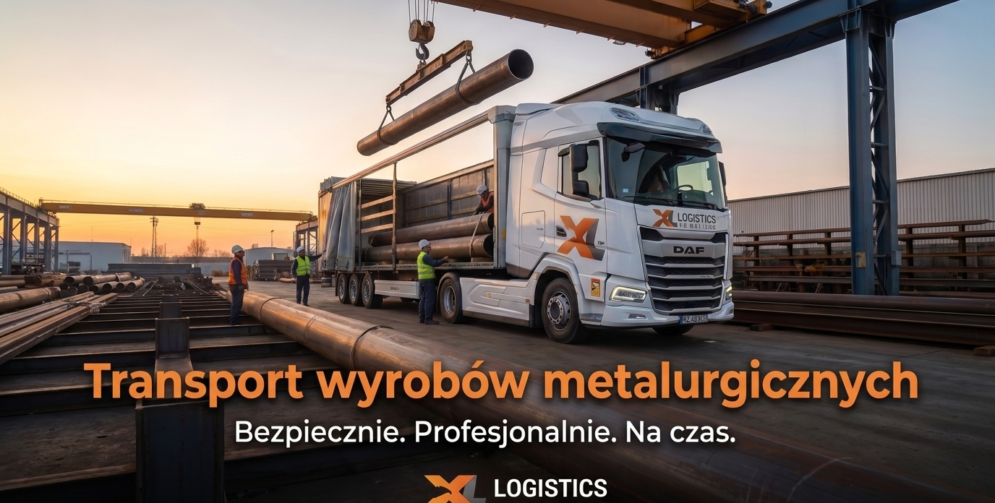
- Tarpaulin-covered semi-trailers (standard) — are ideal for transporting sheet metal, lattice profiles, and pipes of standard lengths. The side walls and tarp provide protection from the elements, and side loading is convenient when using a crane.
- Drop-side trailers (coilmulde / mulda) — a specially contoured recess in the trailer floor, designed for transporting steel coils. It prevents the load from rolling and allows it to be securely fastened with straps.
- Flatbed trucks and trailers — for long profiles or steel structures that exceed standard dimensions. The absence of side walls allows for easy loading from the side and from above using a crane.
- Oversized transport — when the steel components being transported exceed 13.6 m in length, 2.45 m in width, or 2.75 m in height, or when their weight exceeds 24 metric tons, it is necessary to obtain the appropriate permits and plan a route that takes all restrictions into account.
Load Securing — Regulations and Practice
Properly securing metal products is a legal requirement and ensures road safety. Polish regulations (the regulation on technical requirements for vehicles) and the PN-EN 12195 standard specify the requirements for securing force in relation to the load weight.
The following are used in steel transportation:
- high-strength conveyor belts with properly spaced attachment points,
- rubber, wooden, or fabric pads to prevent friction and scratches,
- spacers and separators to maintain the proper distances between components,
- Proper cargo marking—warning signs, flags, and position lights for nighttime transport.
Improper protection can lead to deformation of steel profiles, weld cracks, or damage to anti-corrosion coatings.
The number of lashing straps depends directly on the weight of the load—each strap has a specific load capacity (LC) indicated on its label. The driver is responsible for ensuring that the load is secure while driving and is required to check it after each stop.
Not only the carrier but also the shipper is responsible for improper securing of the cargo. This is important information for the logistics departments of metallurgical companies—the responsibility for proper loading lies with both parties.
When does a double-deck setup make sense in metallurgy?
A double-deck semi-trailer—that is, a vehicle with two loading levels—is primarily associated with the transport of light goods on pallets. However, there is a specific niche in the metallurgical industry where a two-deck ship makes economic sense.
It is ideal for transporting lightweight metal products: small aluminum profiles, thin-gauge sheet metal parts, metal accessories and fasteners, tools, frames, and small metal goods. The key requirement is that the pallet’s weight not exceed 750–800 kg—in that case, both levels can be fully utilized and up to 66 Euro pallets can be loaded.
In practice, this means that a manufacturer of small metal products or a distributor of accessories that regularly ships large volumes of lightweight pallets can cut the number of trips in half. For regular routes, such as Poland–France: The savings are immediately measurable.
However, the Double Deck cannot replace a standard semi-trailer or flatbed when transporting heavy sheet metal, steel coils, or structural profiles. It’s mass that matters here—not volume.
For more information on how Double Deck reduces transportation costs and the carbon footprint, see our article [Double-Deck Transportation—When to Use It and What Savings It Offers].
Documentation for the Transport of Metal Products
Domestic transport of steel products does not require any special documents other than the standard CMR consignment note (for international transport) or the WZ document (for domestic transport). However, it’s a good idea to document the cargo—the type of steel, weight, dimensions, and condition of the coatings—as this information may be needed in the event of a damage claim.
When exporting outside the EU or importing from third countries, customs documents, certificates of origin, and material certificates are required—especially for steel subject to anti-dumping duties, where the country of origin is critical for customs clearance.
Transportation of Metallurgical Products with XL LOGISTICS
In practice, the transport of steel products requires working with an experienced logistics provider that has a fleet equipped to handle heavy and non-standard cargo.
XL LOGISTICS transports metallurgical products on domestic and international routes—including regular routes between Poland and France, Poland and Germany, and Poland and the Benelux countries. We have tarpaulin-covered semi-trailers designed for side loading, experienced drivers familiar with the requirements of the metallurgical industry, and dispatchers available around the clock.
If you are planning to transport steel products and would like to discuss the details, please contact our sales department. We provide quick and accurate quotes.