
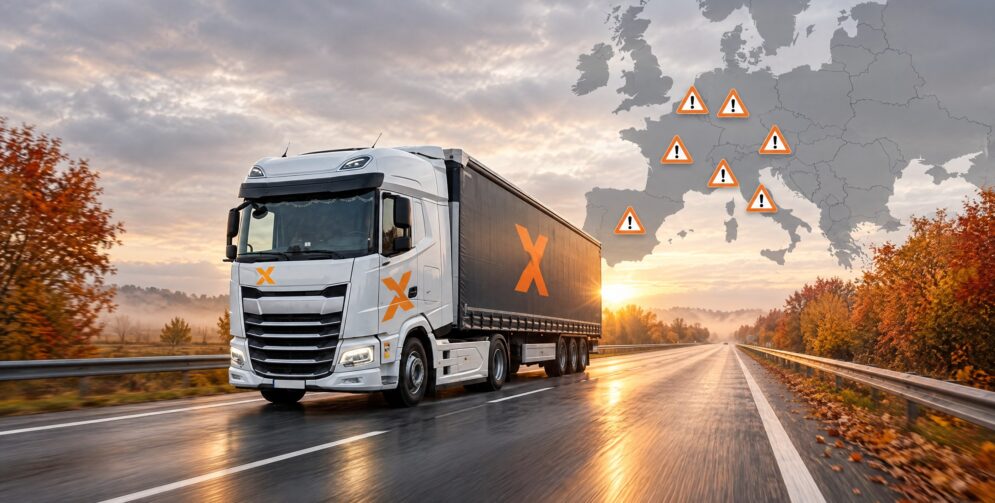
From October through the end of the year, a truck traveling through Europe passes through at least nine different driving bans. In Germany, France, and Slovakia, you can’t drive on Sundays from midnight to 10:00 p.m.; in Italy, from 9:00 a.m.; in the Czech Republic, not until 1:00 p.m.; and in Poland, the ban does not apply every Sunday, only on public holidays, and it starts at 12 metric tons, not 7.5. Below is a complete list of times, weight limits, and dates that will halt transport through January.
Where and during what hours does the ban apply until the end of the year?
Weekend bans are a permanent rule enshrined in national traffic codes, not a decision made on a month-to-month basis. The table below shows the regulations outside the summer season—that is, those in effect until spring.
| Country | Weight limit | Sundays and holidays | Notes |
|---|---|---|---|
| Germany | over 7.5 metric tons | 12:00 a.m. – 10:00 p.m. | The Saturday ban applies only during summer vacation; outside of that period, it does not apply |
| France | over 7.5 metric tons | Saturday 10:00 p.m. – Sunday 10:00 p.m. | Bison Futé publishes an annual calendar with additional days |
| Austria | over 7.5 metric tons | Saturday 3:00 PM – Sunday 10:00 PM | Additionally, a nighttime driving ban is in effect from 10:00 PM to 5:00 AM year-round |
| Italy | over 7.5 metric tons | 9:00 a.m. – 10:00 p.m. | Dates are set by an annual ministerial decree |
| Czech Republic | over 7.5 metric tons | 1:00 PM – 10:00 PM | Saturday ban only in July and August |
| Slovakia | over 7.5 metric tons | 12:00 a.m. – 10:00 p.m. | On the day before a public holiday: 7:00 a.m. – 7:00 p.m. |
| Hungary | over 7.5 metric tons | Saturday 10:00 p.m. – Sunday 10:00 p.m. | Weekend Package (Off-Season) |
| Switzerland | over 3.5 metric tons | All day Sunday | Lowest threshold in Europe plus a nightly ban from 10:00 PM to 5:00 AM every day |
| Slovenia | over 7.5 metric tons | 8:00 a.m. – 10:00 p.m. | |
| Spain | over 7.5 metric tons | 8:00 a.m. – midnight | The schedule and routes are determined by an annual decision of the DGT |
| Poland | over 12 metric tons | 8:00 AM – 10:00 PM, only on public holidays | Regular Sundays without restrictions, except during summer vacation |
| Romania, Bulgaria, Lithuania, Latvia | – | no permanent weekend ban | Restrictions imposed on an ad hoc basis during holidays |
How does the Polish ban differ from the German one?
In two ways, and both can come as a surprise to a carrier planning a route from Poland to the west. The first is the weight limit. In Poland, the ban applies to vehicles with a gross vehicle weight rating (GVWR) exceeding 12 metric tons; in Germany, Austria, the Czech Republic, and most of the EU, it applies to vehicles exceeding 7.5 metric tons. A truck-trailer combination that is legal in Poland is prohibited in Germany.
The second difference is the range of days. The German ban applies to every Sunday of the year. The Polish ban applies only on statutory holidays, and outside of the summer vacation period, regular Sundays are open to trucks. Added to this is the start time: 8:00 a.m. in Poland, and midnight in Germany, France, and Slovakia. An eight-hour difference determines whether you’ll make it across the border in time.
On which days in January will transportation be suspended?
The holidays fall at an exceptionally inconvenient time this quarter. All Saints’ Day falls on a Sunday, which means the holiday overlaps with the standard Sunday ban. Christmas falls on Friday and Saturday, followed immediately by Sunday, December 27. That’s three consecutive days off in countries where the ban applies to holidays that fall on a Saturday.
| Date | Day | Effective Date |
|---|---|---|
| November 1 | Sunday | All Saints’ Day. Poland 8:00 a.m. – 10:00 p.m., plus the usual Sunday restrictions in Germany, Austria, Italy, France, and Spain |
| November 11 | Wednesday | Independence Day in Poland 8:00 a.m. – 10:00 p.m. and Armistice Day in France 12:00 a.m. – 10:00 p.m. |
| December 8 | Tuesday | Immaculate Conception. Italy 9:00 a.m. – 10:00 p.m. according to the 2026 calendar |
| December 24 | Thursday | France 10:00 PM – midnight, Poland 6:00 PM – 10:00 PM as the day preceding a holiday |
| December 25 | Friday | Christmas. Banned in Poland, Germany, France, Austria, Italy, and Spain |
| December 26 | Saturday | Boxing Day. Poland 8:00 a.m. – 10:00 p.m., Germany 12:00 a.m. – 10:00 p.m., Italy 9:00 a.m. – 10:00 p.m. |
| December 27 | Sunday | A regular Sunday with the standard ban throughout Western Europe |
| December 31 | Thursday | France 10:00 PM – 12:00 AM |
| January 1, 2027 | Friday | New Year’s Day. Ban in Poland, Germany, Austria, and France |
The Italian calendar for 2026 is established by Ministry of Transportation Decree No. 325 of December 12, 2025. It covers all Sundays in October, November, and December from 9:00 a.m. to 10:00 p.m., plus December 8, 25, and 26. The decree applies exclusively to the 2026 calendar year, so the dates for January 2027 must be checked after the new calendar is published.
When do winter tires and snow chains become mandatory?
The deadlines vary by a few weeks from country to country, and the nature of the requirement varies even more. Some countries require winter tires starting on a specific date regardless of the weather, while others require them only when there is actually snow or slush on the road.
| Country | Period | Nature of the obligation | Requirements |
|---|---|---|---|
| Austria | November 1 – April 15 | Fixed, over 3.5 metric tons | M+S or 3PMSF tires on the drive axle, tread depth of at least 5 mm, chains on board |
| Czech Republic | November 1 – March 31 | Conditional, over 3.5 metric tons | Winter tires on the drive axle, tread depth of at least 6 mm, in snow and ice |
| Slovakia | November 15 – March 31 | Mandatory, categories N2 and N3 | Winter tires on the drive axle, tread depth of at least 3 mm throughout the entire period |
| Italy | usually November 15–April 15 | Depends on the region | Winter tires or snow chains on board; requirements are set by road authorities |
| Germany | no fixed date | conditional | In the event of black ice and snow, the 3PMSF marking is required; the M+S marking alone will not be sufficient starting in October 2024 |
| Poland | – | No requirement | Snow chains are permitted only on designated roads |
Which types of cargo are exempt from the bans?
The list of exceptions varies by country, but the core elements are consistent across Western Europe. Exemptions most commonly include:
- fresh milk, meat, and fish, as well as perishable fruits and vegetables
- live animals and the feed necessary for their care
- combined transport, in Germany for distances of up to 200 km from a rail terminal and up to 150 km from a port
- mail and newspapers
- fuel delivered to stations and ports
- roadside assistance and maintenance service vehicles
- empty return trips directly related to the transport covered by the exemption
Any exception must be documented. Inspectors do not check what you could theoretically be carrying, but rather what is listed in your shipping documents. For perishable cargo, what counts is the type of goods listed on the CMR, not the driver’s declaration.
How can you plan your transport so that a ban doesn’t delay your delivery?
The ban is predictable, so it only incurs costs when a route is planned at the last minute. At XL LOGISTICS, we plan our trips with the ban calendar in hand, and for deliveries due Monday morning, we use three solutions.
Double crew. Two drivers take turns at the wheel, so the truck doesn’t have to stop for an overnight rest. Travel time is cut in half, allowing the route to be completed before Friday evening instead of getting stuck in Bavaria for the weekend.
Transshipment at the base. Any cargo that doesn’t make it across the border before the ban takes effect is picked up by a second truck on the other side. The goods continue on their way instead of waiting in a parking lot until 10:00 p.m. on Sunday.
Earlier loading. Shifting the loading time by half a day costs less than a day’s layover. For deliveries on January 1 or December 27, this is usually the only solution, since it’s impossible to bypass three consecutive days of the ban.
Frequently Asked Questions About Traffic Restrictions
Does the ban apply to empty vehicles?
Yes. In Germany, Austria, and France, the ban applies to vehicles exceeding the weight threshold regardless of whether they are carrying a load. An exception is an empty trip directly related to a shipment covered by an exemption, such as the return trip after delivering fresh food.
What are the consequences of violating the ban?
Fines are imposed on the spot and vary by country. In Germany, the fine applies to both the driver and the carrier, and the vehicle is impounded until the end of the ban period. In addition to the fine itself, there is the cost of the delayed delivery, which is usually higher.
Does the ban apply to all roads?
In most countries, yes, on public roads. Exceptions usually apply to travel to a rail terminal, port, or unloading site located near the border. In Poland, vehicles are exempt within a 50-km radius of the state border.
Does ADR transport have separate rules?
Dangerous goods are subject to the same weekend bans, but these are supplemented by tunnel restrictions and local bans on the transport of specific classes of goods. In Tyrol, there is an additional sector-specific ban on the A12 highway for selected groups of goods, with the exception of vehicles that meet the Euro VI standard.
Where can I find the current dates for the coming year?
Italy publishes its calendar by decree of the Ministry of Transportation; France does so through Bison Futé; and Spain does so by decision of the DGT. Germany, Austria, and Poland do not issue annual calendars because their driving bans are directly stipulated by law and coincide with statutory holidays.
Sources
- Germany: BALM, truck driving bans, Section 30(3) of the StVO
- France: Bison Futé, general regulations, and the 2026 calendar
- Italy: Ministry of Infrastructure and Transport, Decree No. 325 of December 12, 2025
- Austria: WKO and the State of Tyrol
- Switzerland: ASTRA
- Slovenia: promet.si
- Poland: Regulation of the Minister of Transport dated July 31, 2007, on periodic restrictions and bans on the operation of certain types of vehicles on roads
We checked the times and dates in the second half of September 2026. National calendars are sometimes updated during the year, so before traveling on a holiday, please confirm the schedule with the road authority or contact our shipping department.
Are you planning to ship something during the holiday season?
Leave your phone number, and our freight forwarder will calculate the route, taking into account any restrictions, and suggest a loading date that ensures on-time delivery. Also, find out how double-crew express transport and international transport work at XL LOGISTICS.
