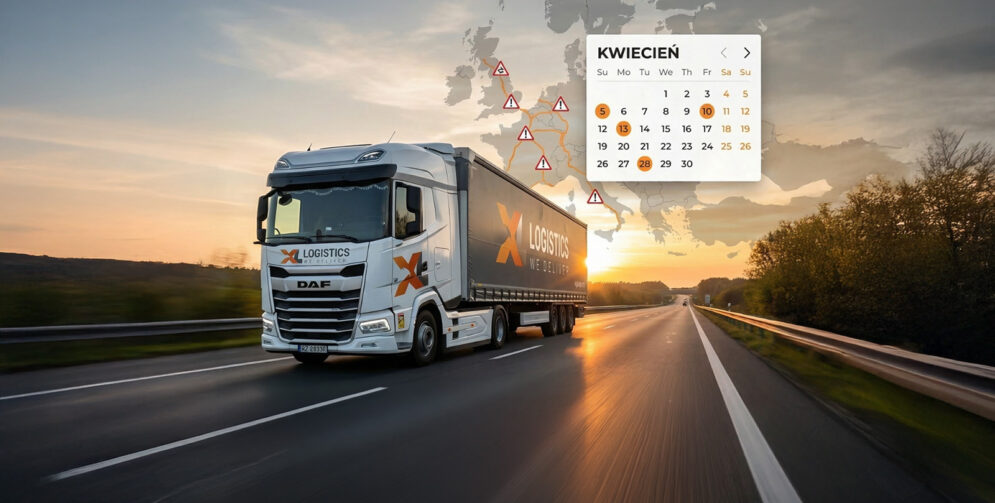
Traffic bans for trucks in Europe April 2-7, 2026
The operational challenge for international transport
The Easter holiday period in Europe has for years meant an accumulation of restrictions on truck traffic. In 2026, the wave of bans begins as early as April 2 and simultaneously covers multiple countries, different time frames and different rules.
For companies operating in international transportation, it is not just a matter of knowing the calendar. This is a complex operational challenge that affects the planning, timely execution and profitability of the entire logistics process.
Traffic bans – schedule (April 2-7, 2026)
April 2 (Thursday)
- Austria (A12, A13, A14 – direction Italy): 07:00-22:00
- Luxembourg (direction Germany): 23:30-24:00
- Hungary: 22:00-24:00
April 3 – Good Friday
- Germany: 00:00-22:00
- Switzerland: 00:00-24:00
- Slovakia: 00:00-22:00
- Hungary: 00:00-22:00
- Czech Republic: 13:00-22:00
- Slovenia: 14:00-22:00
- Italy: 14:00-22:00
- Croatia: 15:00-23:00
- Luxembourg: 00:00-21:45
April 4 (Saturday)
- Austria: 15:00-24:00
- France: 22:00-24:00
- Poland: 18:00-22:00
- Italy: 09:00-16:00
- Hungary: 22:00-24:00
- Croatia: 15:00-23:00
- Luxembourg: evening restrictions (FR/DE directions)
April 5 – Easter Sunday
Bans are in effect in most European countries, including:
Austria, Germany, France, Poland, Switzerland, Hungary, Slovakia, Slovenia, Czech Republic, Italy, Croatia, Luxembourg, Liechtenstein
(in many cases at or near 00:00-22:00)
April 6 – Easter Monday
Continued restrictions in most European countries:
Austria, Germany, France, Poland, Switzerland, Slovakia, Slovenia, Czech Republic, Hungary, Italy, Croatia, Luxembourg
April 7 (Tuesday)
- Italy: 09:00-14:00
Regulatory complexity – why is it a real operational risk?
Traffic bans in Europe are not a uniform system.
Each country applies its own regulations, which vary in both scope and interpretation.
The most important factors affecting the difficulty of planning:
- different hours of prohibition
- restrictions covering only selected sections (e.g., specific highways or regions)
- exceptions for certain categories of cargo
- so-called. “crossing windows” that allow temporary continuation of transportation
- dynamic changes communicated in a short period of time
In practice, this means that a single transport may require a multi-stage analysis even before implementation begins.
Impact of bans on the supply chain
The accumulation of restrictions in many countries at the same time has a domino effect on the entire logistics chain.
Most common consequences:
- increased risk of delivery delays
- Increase in transportation lead time
- the need for dynamic route changes
- Increased pressure on driver and fleet availability
- Risk of disruption of continuity of supply at customers
During this period, transportation ceases to be a predictable linear operation.
It becomes a process that requires ongoing response to changing conditions.
Transport planning under constraints
At XL LOGISTICS, we view periods of increased restrictions as operational risk management, not just route planning.
Our approach includes:
- A detailed analysis of the bans for each country and day
- route planning taking into account constraints and alternatives
- ongoing monitoring of regulatory developments
- preparation of emergency scenarios
- securing continuity of supply for customers
This approach minimizes the impact of constraints on transportation implementation.
Summary
The period from April 2 to 7, 2026 is one of the most challenging times for road transportation in Europe.
In such conditions, the advantage is gained by companies that not only realize transportation, but can anticipate and plan it accordingly.
Because in modern logistics, the key is not the implementation itself.
Predictability is key.