
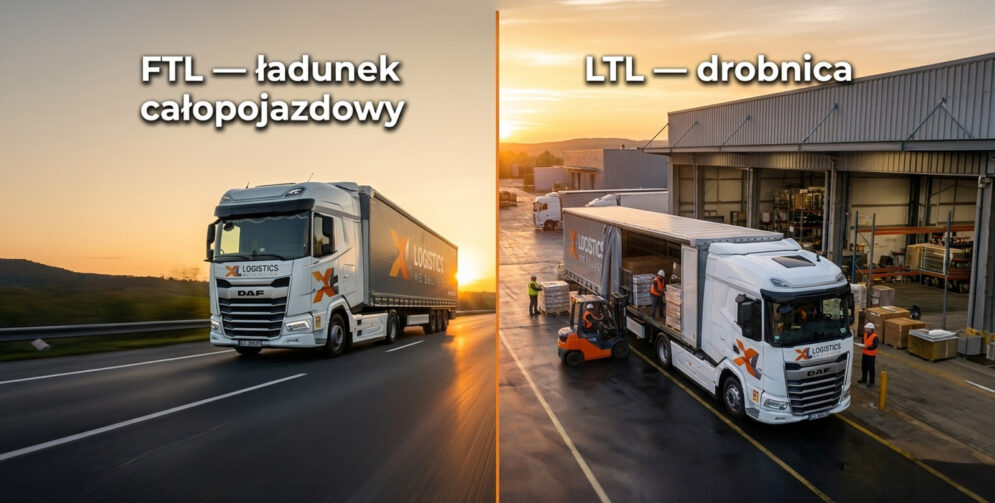
FTL and LTL transportation – what’s the difference and when to choose the right solution
The decision to choose between FTL and LTL transportation comes up regularly in the work of any logistics or purchasing manager. At first glance, it may seem like a technical trifle. In practice, it affects delivery time, cargo security and the cost of the entire operation. Choosing the wrong model can generate unnecessary expenses or delays that take a toll on the entire supply chain.
In this article, we explain exactly how FTL and LTL transportation differ, when each solution makes sense, and what to look for before you make a decision.
What is FTL transportation?
FTL stands for Full Truck Load – in Polish: full truck load. This means that you rent the entire trailer for yourself. Your goods go as the only cargo, without adding other shipments, without additional loading along the way.
The FTL model works especially well for large volumes – usually talking about cargoes exceeding 10-12 tons or taking up more than half of the cargo space. But weight alone is not the only criterion.
The main advantages of FTL transportation:
- Cargo security – goods go directly from point A to point B, without transshipment. Fewer cargo operations means less risk of damage.
- Shorter transit time – the vehicle does not stop at other recipients. Delivery proceeds without unnecessary interruptions.
- Lower unit cost for large batches – you pay for the whole trailer, but for high volume the rate per ton is much more favorable than in the LTL model.
- Operational simplicity – one contract, one vehicle, one driver, one bill of lading.
FTL is also a natural solution for sensitive goods, irregular in size or requiring special conditions – temperature-controlled transport, hazardous materials (ADR) or high-value products, where safety outweighs cost optimization.
What is LTL (less-than-truckload) transportation?
LTL(Less Than Truck Load) – in Polish, general cargo or part load – is a completely different approach. Your goods do not travel independently. The trailer space is shared among several different shippers, and the logistics operator consolidates cargo from different pick-up points and delivers it to different recipients in a single run.
To make this possible, you need the right infrastructure – transshipment terminals and a well-organized distribution network. The cargo first arrives at the terminal, where it is consolidated with other shipments, before continuing on to the consignee.
When LTL makes sense:
- You ship smaller batches of goods – a dozen or a few hundred kilograms, a few pallets.
- You don’t have regular, large orders and need flexibility in your schedule.
- The priority is to optimize costs with low volumes – you pay only for the space occupied.
- You deliver goods to many different customers in different locations.
The main advantage of LTL is that you don’t have to wait until you collect volume for a full trailer. You can ship the goods when they are ready, even in small quantities.
However, there are several aspects to keep in mind. Cargo in general cargo is transshipped – usually at least once at a transshipment terminal. This increases transit time and statistically increases the risk of damage, especially to fragile or storage-sensitive products. When planning the delivery time, it is worth considering an additional 24-48 hours over FTL.
FTL vs LTL – key differences at a glance
| FTL | LTL (general cargo) | |
|---|---|---|
| Who uses the trailer | One sender | Many broadcasters |
| Transshipments along the way | No | Usually 1-2 |
| Transit time | Shorter | Longer |
| Risk of damage | Lower | Higher |
| Cost at low volume | High | Beneficial |
| Cost at high volume | Beneficial | High |
| Flexibility | Lower | Higher |
| Typical volume | 10+ tons / 33 Europallets | Even single pallets |
There is no single answer as to which model is better. The decision always depends on the specific load, schedule and budget.
When to choose FTL and when to choose LTL?
Several scenarios to help you decide:
Select FTL when:
- Your cargo exceeds 10-12 tons or occupies more than half of the trailer – transportation economy speaks for a dedicated vehicle.
- The goods are fragile, valuable or require special conditions of carriage – temperature controlled, ADR, high-value goods, for which each handling is an additional risk.
- The delivery date is a deadline – FTL gives predictability, which general cargo does not always guarantee.
- You ship regularly to the same consignee – regular cooperation with the operator on FTL often allows you to negotiate better terms.
Select LTL when:
- The cargo volume is too small to pay for the whole trailer – LTL is much more economical with a few pallets.
- You ship less frequently and irregularly – general cargo gives you flexibility that FTL doesn’t offer.
- You deliver to multiple customers in different locations – the operator’s handling network then works in your favor.
- Delivery time is secondary to cost – if the product is not time-sensitive, LTL saves.
It is also worth considering the nature of the business itself. Many industrial companies combine the two models – FTL during peak season or with large orders, LTL during quieter periods when volumes are lower. A flexible approach to model selection is often a better strategy than rigidly sticking to one solution.
What else to look for when choosing?
Choosing between FTL and LTL is an important but not the only question to ask yourself. A few issues that are often overlooked at the planning stage:
- The type of goods – products requiring controlled temperatures, hazardous materials (ADR) or oversized goods have their own requirements and not every operator is equipped to handle them. Check before you sign an order.
- Documentation and regulatory requirements – international transport, waste management, food products – each industry has its own legal specifics. A good logistics operator knows these regulations and helps meet them, not just transports the cargo.
- Cargo insurance – especially with general cargo, it is useful to know under what rules the goods are covered and what happens in case of damage.
- Industry experience of the operator – a company that has already transported similar cargoes and understands the specifics of your industry is able to avoid mistakes that cost money. Price should not be the only selection criterion.
XL LOGISTICS – we match the solution to your cargo
For nearly 20 years, we have completed thousands of shipments for clients in more than 60 industries – from automotive and food, to petrochemicals and waste management. We handle FTL full truckloads, organize groupage and offer specialized solutions where standard models are not enough – including our flagship Double Deck system.
If you do not know which solution will be right for your cargo – contact us. We will analyze your needs and select a transportation model that meets both your operational requirements and budget.