
Your business partner is waiting for a component. The production line has been shut down since this morning. The recipient’s warehouse only accepts deliveries until a certain time, and any delay disrupts the entire unloading schedule. In situations like these, every hour counts, and standard transportation solutions simply aren’t enough.
A two-driver crew, known in the industry as “Double Driver,” is the solution to this problem. It significantly reduces delivery times on long routes without violating regulations on drivers’ working hours. We explain how it works, when it’s really worth it, and what you should know before arranging this type of transport.
What is a two-driver crew?
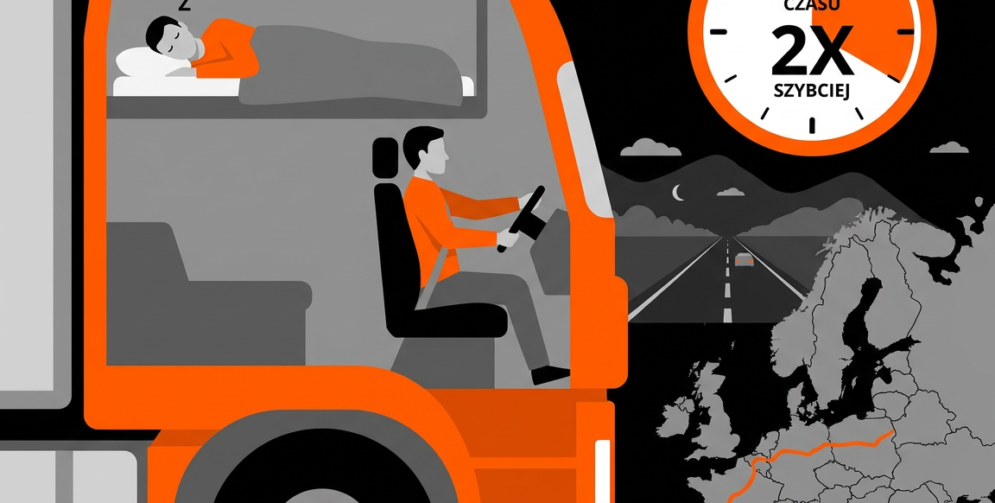
Double Driver is a system in which two certified CE-category drivers travel in the cab of a single truck. One is driving, the other is resting in the cab. As a result, the vehicle does not have to stop for mandatory breaks or overnight stops.
The legal basis is EC Regulation No. 561/2006, which regulates driving and rest times for professional drivers. According to this provision, when there are two drivers on duty, the co-driver may take a rest in the moving vehicle. It doesn’t require stopping at a parking lot or a motel, which means the truck drives almost nonstop.
For comparison: A driver in a standard crew may drive a maximum of 9 hours per day (exceptionally, 10 hours twice a week) and is required to take a 45-minute break after every 4.5 hours of driving, followed by 11 hours of daily rest. On long trips, that adds up to a dozen or so hours of downtime over the course of a day. With a two-person crew, those hours turn into kilometers.
Why might delivery time cost more than the actual shipping?
Before you start calculating the cost of a second driver, it’s worth asking yourself another question: How much does a single day’s delay cost you?
In just-in-time models, a delayed delivery can bring the production line to a standstill for several hours. For perishable goods or those requiring temperature control, every additional hour on the road results in real losses. In retail and distribution, where the delivery window is strictly agreed upon with the customer, a delay often results in a complaint or the loss of a contract.
Situations in which delivery time is critical:
- just-in-time deliveries for manufacturing plants and assembly lines
- perishable goods that require temperature control
- Express and emergency transport, where response time is critical
- seasonal deliveries with a short time window
- long-distance routes with strict unloading deadlines at the recipient’s location
If your business falls into any of these categories, it’s worth carefully calculating the cost of having two drivers.
How much time and money can you save?
Let’s take a specific example. The distance between Poland and France is about 1,600 km. With a standard crew, the travel time is 2 to 3 days, including mandatory breaks and overnight rest. With a two-person crew, the same distance can be covered in approximately 24 hours, since the vehicle does not stop for the night.
On very long routes, such as Poland to Portugal or Poland to Spain, Double Driver can save you up to 2 full days compared to standard transport. On shorter routes, such as Poland–Germany or Poland–Belgium, the time savings are smaller but still measurable in hours.
What this means for you in practice:
- no storage costs for goods in transit
- Avoiding contractual penalties for late delivery
- maintaining continuity of production or sales at the customer’s site
- faster return of the vehicle and the ability to accept the next job
The cost of a second driver is a real concern. But with the right setup, it’s an investment that more than pays for itself with just one instance of avoided production line downtime.
When does the Double Driver make sense, and when doesn’t it?
A two-driver crew isn’t the right solution for every job. Before you decide on this option, check to see if your situation is a good fit for it.
Double Driver works well when:
- The route is over 1,000 km long, and every hour saved counts
- The delivery time is set to the hour and is non-negotiable
- The shipment is sensitive to delays, e.g., manufacturing components, food, and pharmaceuticals
- The seasonal peak creates time pressure given the limited availability of appointments
- Transportation is available on routes with a limited number of parking spaces and lodging options
Dual casting is less justified when:
- The route can be covered in a single driver shift, which is about 450–500 km
- Delivery dates are flexible or span several days
- The priority is solely the lowest freight cost, with no time pressure
An experienced freight forwarder will assess whether, in a specific case, double booking will result in actual net savings or will merely increase the freight cost. It’s worth considering this before every order.
What are the requirements for drivers and the client?
Double Driver is not only an operational decision but also a formal commitment. It’s a good idea to familiarize yourself with the basic requirements before placing an order.
From the drivers’ perspective:
- Both must hold a valid CE driver’s license
- Both must have a valid tachograph driver card and a valid initial qualification
- Both must be logged into the tachograph at the start of the route
- If the cargo is subject to ADR regulations, both drivers must have the appropriate certificate
On the client’s side:
- The shipping documents (CMR) should accurately reflect the terms of transport
- For regulated goods, such as ADR cargo, ATP-class food, or waste, additional requirements apply that are independent of the vehicle’s crew
- It is a good idea to check with the carrier in advance to see if the route requires special permits in transit countries
If you have any questions about the documentation, a trucking company with experience in double crews will guide you through the process, so you won’t have to search through the regulations on your own.
Double Driver at XL LOGISTICS
XL LOGISTICS provides transport services with two drivers on international routes, with a particular focus on routes requiring rapid transit through Western Europe. If you want to shorten delivery times while ensuring full compliance with regulations, check out our express shipping services.
We are looking for CE-licensed drivers for two-person crews. If you have a CE driver’s license, a valid driver card, and are interested in working in a two-driver rotation on international routes, please contact us. We offer stable terms of cooperation, a modern fleet, and the opportunity to work with a partner that has specialized in European transportation for 19 years. You can find details about the job opening in the “Careers” tab.
Does a dual cast make sense in your case?
If you regularly make long-distance deliveries with strict deadlines, Double Driver can change the economics of your entire transport operation. It’s not just about speed, but above all about the assurance that the goods will arrive on time, regardless of the distance.
Please contact us and tell us about the route you’re planning. We’ll help you determine whether a two-driver crew is the right solution for your job.
